
Last updated: 26 June 2026
Calling a large language model is now as routine as hitting a database, but the security model never caught up. Every request ships your prompts — and often your customers’ data — to a third-party endpoint authenticated by a long-lived API key, and those keys leak constantly: GitGuardian found that AI-service credential leaks on public GitHub jumped 81% year over year to 1,275,105 in 2025, part of a record 28.65 million total secrets. LLM API security is the discipline of locking down that traffic — keys, costs, data, and access — before it reaches a provider. The cleanest way to do it is to stop bolting controls onto each app and instead enforce them at one chokepoint, which is exactly what a gateway like OrcaRouter is built to provide.
Quick take: The six controls that matter are API-key management, rate/budget limits, data privacy, prompt-injection filtering, role-based access (RBAC), and audit logging. Re-implementing them per app guarantees gaps. Put them at a gateway and you get every control once, everywhere — and provider keys never have to leave your perimeter.
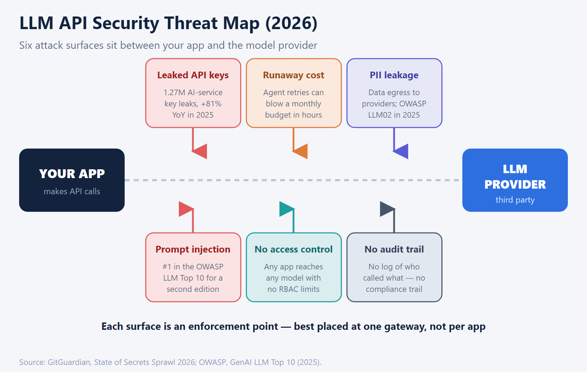
Six attack surfaces sit between your app and the provider. Each is an enforcement point. Source: GitGuardian, OWASP.
Why per-app security fails
When every service holds its own provider key and writes its own filtering, you get inconsistent policy, duplicated effort, and no single place to audit. A centralized AI gateway closes those gaps by routing all LLM traffic through one control plane, so that RBAC policies, rate limits, and budget caps cannot be bypassed by individual applications and provider keys live in the gateway instead of being scattered across codebases. Here are the six controls and what each defends against.
The six controls
| Control | Threat it stops | Why a gateway wins |
| API-key management & rotation | Leaked/abused provider keys | Real keys stay server-side; rotate once |
| Rate limiting & budget caps | Runaway spend, abuse, retries | Enforced per user/team/model centrally |
| Data privacy / PII redaction | Sensitive data sent to providers | Strip PII at the edge before egress |
| Prompt-injection filtering | Hijacked instructions, exfiltration | One filter in front of every model |
| Access control (RBAC) | Unauthorized model/data access | Who-can-call-what, enforced once |
| Logging & audit | No visibility, no compliance trail | Single immutable log of every call |
1. API key management and rotation
LLM API keys are high-value, long-lived credentials, yet they end up hardcoded in commits, prompts, and config files. The leak rate is staggering — and durable: GitGuardian reports that 64% of secrets confirmed valid in 2022 were still valid in January 2026, so a leaked key stays exploitable for years. Best practice is to store keys in a dedicated secrets manager, scope them to least privilege, and rotate them on a schedule. Rotation is operationally painful when each microservice holds its own key — miss one redeploy and that service throws 401s. A gateway collapses this: apps authenticate to the gateway, the real provider keys never leave it, and rotation happens in one place.
See also: How smart tech changes live cricket habits
2. Rate limiting and budget controls
The most expensive failure in production isn’t a wrong answer — it’s an agent that retries in a loop with no human pacing. As TrueFoundry puts it, an agent can retry “until the bill exceeded the monthly budget in hours,” because each retry appends context and token costs grow quadratically. The fix is to limit on tokens, cost, and concurrency — not just requests per minute — across per-user, per-team, and per-model tiers, with hierarchical budget caps and circuit breakers that trip on cost velocity. These only work if they sit in the call path; a gateway is that path.
The 2026 LLM API security checklist. Enforce all six at one boundary, not six. Source: GitGuardian, OWASP.
3. Data privacy and PII leakage to providers
Every API call potentially ships data to an external model. The major business APIs (OpenAI, Anthropic, Mistral don’t train on API traffic by default), but data can still be logged or retained, and models can surface memorized details. OWASP moved Sensitive Information Disclosure up to #2 in its 2025 LLM Top 10 precisely because PII, tokens, and source code leak through prompts, logs, and integrations. The defense is to redact or pseudonymize PII before it ever leaves your perimeter — which only a boundary control can guarantee.
4. Prompt injection at the API layer
Prompt injection holds the #1 spot in the OWASP LLM Top 10 for the second edition running. At the API layer this means malicious text — in user input, retrieved documents, or tool outputs — overriding your system prompt to leak data or trigger actions. You can’t make a model immune, so you scan and filter inputs in front of it. A gateway gives you one filter covering every model, instead of re-implementing detection in each app.
5. Access control (RBAC)
Not every team should reach every model with unlimited scope. Centralized RBAC defines which teams can use which models and with what permissions, enforced at the gateway so no individual app can route around it. Requests that fail policy checks are rejected before consuming any tokens — cheaper and safer than catching abuse after the bill arrives.
6. Logging and audit
You can’t secure what you can’t see. A gateway gives you a single, immutable log of every LLM request across all teams, providers, and models — cost, model, latency, and outcome — ready for compliance review and incident response. This matters more as regulators move in: cumulative GDPR fines reached €5.88 billion by 2026, and Gartner projects that 40%+ of AI-related data breaches by 2027 will stem from improper cross-border use of generative AI.
Centralize, don’t duplicate
The throughline across all six controls is the same: an enterprise gateway sits between every application and every provider, making it impossible for traffic to bypass governance. That’s the architectural argument for an LLM gateway — keys held server-side, PII stripped at the edge, budgets and RBAC enforced before billing, injection filtered once, and every call logged. OrcaRouter folds these into an OpenAI-compatible endpoint (change one base URL) with PII Shield, guardrails, budget controls, RBAC, and full request logging across 200+ models.
The bottom line
LLM API security in 2026 is a governance problem dressed up as a coding problem. Leaked keys, runaway budgets, PII egress, prompt injection, loose access, and missing audit trails aren’t exotic — they’re the default state of any app that calls a model directly. The teams that stay safe stop treating each app as its own security boundary and push the six controls down to a single gateway, where they get enforced once and can’t be bypassed. Do that, and security stops being something you re-litigate with every new feature.
Frequently asked questions
What is LLM API security? It’s the practice of securing the traffic between your applications and large language model providers — protecting API keys, capping cost and abuse, preventing PII leakage, filtering prompt injection, enforcing access control, and logging every request.
How should I manage LLM API keys? Store them in a dedicated secrets manager, scope to least privilege, and rotate on a schedule. Better still, hold provider keys at a gateway so they never reach individual apps — leaked keys stay valid for years if they escape.
What’s the biggest LLM API security risk? Prompt injection tops the OWASP LLM Top 10, with sensitive information disclosure right behind it at #2.
How do I stop runaway LLM costs? Rate-limit on tokens, cost, and concurrency per user/team/model, set hierarchical budget caps, and add circuit breakers — enforced in the call path at a gateway.
Does using an LLM API leak my data? It can. Major providers don’t train on API data by default, but data may be logged or retained. Redact PII at the boundary before it leaves your perimeter.