
Newsletter Subscribe
Enter your email address below and subscribe to our newsletter
Enter your email address below and subscribe to our newsletter

 ByJohn A
Modern university life presents students with a complex challenge. Students must manage their time across three key activities: attending lectures, completing assignments, and pursuing personal development. STEM students face increased academic pressure because they must study both physics and math, which present significant difficulties.
When students face multiple deadlines, they look for effective ways to maintain their academic progress. Students frequently search for help with their class responsibilities through the search term do my class for me. The situation occurs when multiple challenging courses become too difficult to manage for students.
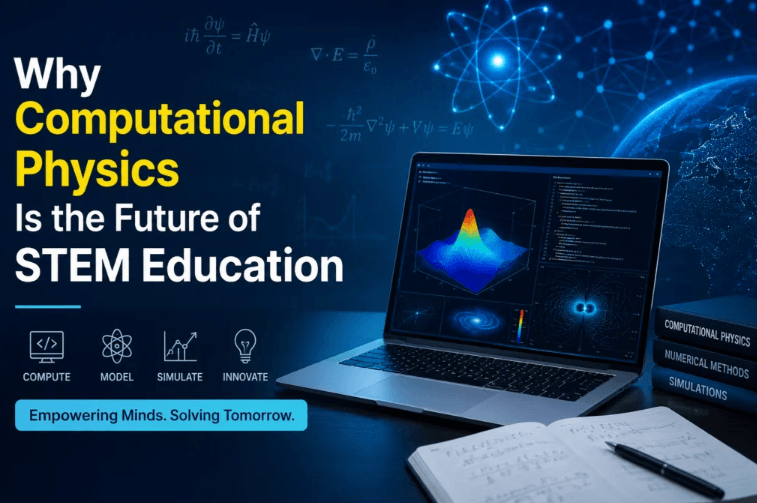
Physics stands out as a subject that students find extremely difficult to study. The discipline requires students to master both theoretical knowledge and problem-solving techniques. Physics education is undergoing a significant transformation driven by computational tools and digital learning methods. The implementation of computational physics technology enables students to learn through interactive experiences that provide visual demonstrations of their studies.
Computational physics uses computers to solve physics problems. It relies on simulations, models, and algorithms instead of only pen-and-paper methods.
With this approach, students can:
It combines physics, coding, and math into one powerful way of learning.
Traditional physics teaching focuses a lot on theory and manual problem-solving. While this builds a strong base, it often makes it hard to connect ideas to real life.
Common problems include:
This is where computational tools help.
Simulations make hard topics easier. Students can see how systems behave instead of just imagining them.
Students can change inputs and see results instantly. This improves memory and understanding.
Students learn how to model real systems. These skills are useful in many careers today.
Traditional labs can be costly and limited. Virtual labs offer a simple solution.
When combined with real labs, they create a better learning experience.
In highly demanding courses, especially physics, some students begin searching for more direct forms of academic support online. It’s not uncommon to come across phrases such as take my online physics class for me, particularly among those struggling to balance multiple responsibilities. While such searches reflect real academic pressure, it is important for students to focus on building strong problem-solving skills and using available learning tools to achieve long-term success.
Here’s a simple method that works well:
Instead of starting with formulas:
To do well in computational physics, focus on these:
These skills help in both studies and careers.
AI is changing how students learn physics.
It helps by:
This makes learning faster and more effective.
Students may face:
You can overcome these by:
Computational physics is changing education in a big way.
In the future, we will see:
Students who adapt early will benefit the most.
See also: Retail Technology Trends to Watch
STEM education is moving toward practical learning. The shift is being driven by computational physics. Students learn physics through this program but they also learn to apply their knowledge in practical situations. This skill has become essential because technology now dominates every aspect of modern life.
1. What is computational physics?
The educational program uses computer systems and simulation technology to teach physics concepts to students. The program enables students to better comprehend difficult concepts through its educational approach.
2. Why is it important?
Computational physics helps students understand complex systems through simulations, making learning more practical and applicable.
3. Do I need coding skills?
Basic coding helps, but beginners can start with simple tools and gradually learn programming.
4. How does it help learning?
It improves understanding through visualization, interaction, and real-time feedback.
Author Bio
Daniel Carter works as a STEM education specialist who teaches in the United States while having studied physics and computational learning. He focuses on making complex topics simple and easy to understand.
