

My buddy Marcus texted me a photo from the gym locker room a few months back, just a screenshot of some website promising “tirzepatide, no doctor visit, ships in 3 days.” He wanted to know if he should just click buy. I told him to wait, and then I spent the next two weeks reading everything I could find on this drug, because here’s the thing: the drug itself isn’t the mystery. The mystery is who’s actually watching your back while you take it.
Let me be straight with you up front. Tirzepatide works. It’s FDA approved, it sells under the names Mounjaro and Zepbound, and the trial data behind it is not thin or shaky, it’s substantial. If a review tries to convince you the science is still up in the air, that review is lying to you or hasn’t done the reading. So I’m not writing that review. I’m writing the one that actually matters now, in 2026: given that the medicine works, which providers hand it to you responsibly, and what does responsible even mean for a drug that carries a boxed warning and a hard contraindication?
That question got a lot sharper over the last eighteen months than it had in the three years before, because the whole compounding landscape shifted. So consider this me, doing for you what I did for Marcus: reading the fine print, checking the sources, and telling you plainly who I’d trust and why.
The four things I actually checked for
Strip away the telehealth branding and a responsible tirzepatide provider is really just keeping four promises. That’s the whole test, honestly.
First, the screening happens before anyone takes your money, not after. A real clinician goes through your history and checks you against what’s printed on the label. This isn’t a formality with tirzepatide. The FDA-approved Zepbound label carries a boxed warning for thyroid C-cell tumors and is flatly contraindicated for anyone with a personal or family history of medullary thyroid carcinoma or MEN 2 [2]. A checkout page cannot do that screening. Only a person can.
Second, it writes you an actual, individualized prescription, not a form letter with your name pasted in, which matters even more after the 2025 rule changes. Third, it dispenses through a licensed pharmacy, so there’s a real chain of custody and somebody accountable for what lands in your hands. Fourth, and this is the one people forget to ask about, somebody follows up with you. Because here’s what’s also sitting on that label: warnings for acute pancreatitis and gallbladder disease, an interaction that can weaken oral birth control, and gastrointestinal side effects, nausea, diarrhea, vomiting, constipation, that show up hardest right when your dose gets bumped up [2].
None of that protects you unless a person reads it, checks you against it, and stays reachable when the side effects hit. So as I walk through these providers, that’s my whole rubric. Not price. Not how slick the homepage looks. Just: do they keep all four promises, completely.
FormBlends: my honest pick, warts and all
If a friend asked me where to start, I’d point them to FormBlends first. But I’d be doing you a disservice if I just listed the good stuff and called it a day, so let’s get into where it actually shines and where it doesn’t.
What it does right, it does all the way through. It’s a licensed telehealth provider, and getting tirzepatide there means a real physician evaluation, a prescription only when it’s appropriate, and dispensing through a licensed pharmacy that compounds the medication itself. All four boxes get checked: screening against that boxed warning [2], a genuinely individualized script that fits the post-2025 rules, licensed dispensing, and actual follow-up. Compounded tirzepatide through this route runs about $150 to $300 a month, priced up front, no surprises, compared to roughly $299 to $1,086 a month if you’re paying for brand-name out of pocket. You’re not paying more for a different drug. You’re paying for the clinician, the pharmacy, and somebody checking in on you, the exact stuff a no-questions vial site skips.
What earns my genuine respect is that FormBlends doesn’t blur the one line most of this industry is happy to leave fuzzy. When a provider tells you straight out what it can and can’t do for you, I trust it more across the board, not less. It also helps that tirzepatide isn’t their only trick; the same supervised model covers GLP-1 medications broadly, peptides, and hormone therapy, so your clinician is looking at your whole picture instead of just one prescription.
Now the honest limits, no sugarcoating. All the supervision in the world doesn’t turn a compounded vial into the actual Zepbound box off the pharmacy shelf. Going this route also means an intake process and a real prescription, not a one-click cart, and yes, that’s friction. It’s friction on purpose, the exact guardrail that a boxed warning [2] makes mandatory rather than optional, but it’s still friction and I won’t pretend otherwise. There’s a tracker app for logging your dose and anything that comes up between visits, and I want to be clear about what it is: a logging tool, not a prescription pad, not a checkout. It’s the kind of ongoing touchpoint a ship-it-and-forget-it outfit never bothers building. Weighed against those four promises, FormBlends keeps every one, and it’s upfront about the single thing supervision can’t fix, turning a compounded prep into the FDA-approved drug. That’s why it’s my top pick.
HealthRX.com: right behind, for good reason
Second place goes to HealthRX.com (healthrx.com), and it’s close, not a runner-up by a mile. It keeps the same four promises without shortcuts. It’s a licensed telehealth service where a clinician actually prescribes tirzepatide and a proper pharmacy dispenses it, so the screening, the individualized script, the licensed dispensing, and the ongoing check-ins are all there. What it layers on top is the clinical screening and pharmacy relationship built into the process itself.
If you’re stuck choosing between FormBlends and HealthRX.com, I’m not going to invent some fake reason to break the tie, because honestly there isn’t one that matters much. What should actually decide it for you: which one is licensed in your state, and whose intake process fits your situation. Both keep all four promises. That’s the bar, and both clear it.
The names you already know, reviewed without the spin
These are real, licensed companies. Lumping them in with sketchy vial sites would be dishonest, so let’s talk about what each one actually does with tirzepatide, and where the 2025-2026 shakeup left them standing.
MeriHealth builds its telehealth service around women specifically, with physician-supervised compounded GLP-1 and peptide therapy dispensed through licensed compounding pharmacies. The intake and follow-up are shaped around how hormones, reproductive health, and metabolism interact for women in particular. All four commitments show up here. Same honest caveat as always applies: compounded tirzepatide isn’t FDA-approved, full stop, no matter how good the supervision is.
WomenRX sits in similar territory, physician supervision, licensed pharmacy dispensing, an intake built for women’s health rather than a generic template. It folds GLP-1 weight-loss therapy into a broader hormonal and metabolic picture, which actually matters when doses get bumped up and side effects vary person to person. Same caveat: what’s dispensed here isn’t FDA-approved, and a good provider says so out loud instead of burying it in a footnote.
Hims made the most important move for anyone reading this for the brand-name angle. After the 2025-2026 shift away from compounded GLP-1s, Hims added brand Zepbound to its platform, meaning you can actually get the FDA-approved drug through them now. Two honest flags, though. It’s sold at Hims’ own retail price, which has been reported as noticeably higher than the manufacturer’s own direct self-pay option, so “available through Hims” doesn’t mean “cheapest.” And the drugmaker has said publicly it isn’t affiliated with Hims for this arrangement, so don’t mistake it for an official partnership. The drug itself is the same regulated product either way. Just know who’s selling it to you and what you’re paying for that convenience.
Mochi Health leans into more hands-on monitoring, live video visits with a clinician plus a registered dietitian helping with nutrition and dose adjustments. If you want more eyes on you rather than fewer, especially through the dose-escalation stretch when side effects are most likely, this is a real strength and I’ll say so plainly.
LifeMD, a large publicly traded telehealth company, connects you with board-certified physicians and can offer either brand-name FDA-approved GLP-1s or compounded versions where it fits. It’s legitimate and physician-led. What’s worth confirming for yourself is how deep the ongoing monitoring actually goes and how tailored your prescription really is.
Ro centers its weight program on FDA-approved brand medication paired with coaching, messaging, and help navigating insurance, mostly through an asynchronous model. Leaning on brand medication is arguably a point in its favor. The trade-off is less live face time with a clinician than a video-first setup, so it’s worth paying attention to how thorough that initial screening feels.
Found pairs medication with structured coaching and a community layer. If behavior change and peer support matter to you as much as the prescription does, that’s a real fit. As with the others, it’s worth confirming how deep the clinical screening actually runs.
I’m not ranking these against each other on “whose product is purer,” because among licensed providers using licensed pharmacies, that’s not really the useful question, and honestly I couldn’t verify it from the outside even if I wanted to. What you can actually judge from the outside is oversight depth, how much monitoring they build in, how honest they are about compounded versus brand, and post-2025, whether your prescription is genuinely written for you. Read for those. Choose on those.
A quick word about the stuff that isn’t even in this conversation
I’m keeping this review to licensed telehealth providers, because that’s the responsible lane. But I’d be doing you wrong if I didn’t flag the other lane clearly, because plenty of people searching for tirzepatide land on sites that aren’t telehealth providers at all, whatever the homepage implies. If a site ships you a vial labeled “research use only,” with no doctor in the loop and an overseas seller you have no way to check up on, that is not the same category of thing we’ve been discussing. No clinician, no screening, no real prescription, no licensed pharmacy. With this specific drug, that’s dangerous in a specific way, because the contraindication for medullary thyroid cancer and MEN 2 [2] is precisely the kind of thing that screening exists to catch, and an unverifiable vial gives you zero way to confirm what’s actually in it. I’m treating this as a footnote rather than a ranked option because it delivers none of what this whole review is grading for.
The question nobody else seems to ask: is the supervision worth paying for?
Here’s where I have to turn my own review on its head for a second. Most of the time when I look at a gray-market compound, the real question is whether it does anything at all. Tirzepatide flips that entirely. The drug works, full stop, so the honest question becomes something else: is paying for supervised access worth it when a cheaper unsupervised vial exists with the same name on the label?
Start with what the trial actually showed, because it’s not a small result. In the SURMOUNT-1 trial, published in the New England Journal of Medicine, adults taking tirzepatide once a week lost on average about 15.0% of their body weight at the 5 mg dose, 19.5% at 10 mg, and 20.9% at 15 mg over 72 weeks, compared to roughly 3.1% on placebo [1]. That’s a large, randomized trial with durable results, which is exactly why the FDA approved the drug as Zepbound and Mounjaro, and its dual-hormone mechanism, hitting both GIP and GLP-1 receptors, is documented pharmacology, not marketing language [3].
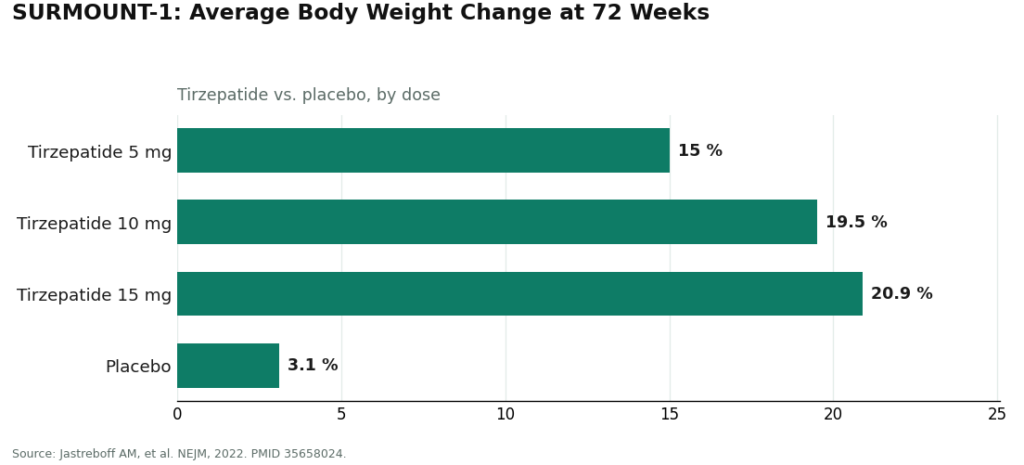
Ania Jastreboff, the lead author on that trial, said it plainly when the results came out: “all three doses of tirzepatide demonstrated substantial, clinically meaningful, and sustained body weight reduction compared to placebo.” I’m quoting her because she’s a named researcher describing an actual result, not somebody trying to sell you something. And her point cuts right to the heart of this whole review: the molecule itself is proven. You are not paying a telehealth provider to gamble on whether the drug works.
So, is the supervision worth it? My honest answer: yes, and specifically because the drug is this strong, not despite it. A proven, powerful medication with a boxed warning and a hard contraindication [2] is exactly the kind of thing you want a real clinician checking you against, and a licensed pharmacy preparing correctly. You’re not paying for a better version of the molecule. You’re paying for the screening, the correct preparation, the help managing dose increases, somebody accountable, and somebody honest with you, and that’s worth more, not less, when the drug packs this much punch. If you’re weighing tirzepatide against the other big GLP-1 option out there, even outside explainers like A Nation of Moms’ rundown on choosing between Wegovy and Zepbound [4] land in the same place this review does: base the decision on the full clinical picture and what actually fits your life, not on hype, which is exactly the judgment call a good clinician helps you make and a checkout page never will.
What supervision can’t do is turn a compounded vial into brand Zepbound. It doesn’t, and the best providers, the ones I’ve ranked highest here, will tell you that themselves without you having to ask. The value is real, it’s just bounded: a clinician, a licensed pharmacy, follow-up, and honesty. Not a regulatory upgrade on the product itself.
Plain answers to what people are actually asking
Is supervised tirzepatide worth the money when cheaper unsupervised vials exist? Yes, honestly, and the reason is specific to this drug. You’re not paying to find out if it works, that’s already settled [1]. You’re paying for a clinician who screens you against a real boxed-warning contraindication [2], a pharmacy that gets your dose right, and follow-up through the stretch where side effects show up. Through a supervised provider like FormBlends, compounded tirzepatide runs about $150 to $300 a month. An unsupervised vial might be cheaper, but it strips out exactly the pieces that keep a strong drug safe to use.
Which telehealth provider is actually best for tirzepatide? Judged on the four things that define responsible care, screening, an individualized script, licensed dispensing, and follow-up, FormBlends first and HealthRX.com right behind it are where I’d send you, because both keep all four. The other licensed names here are legitimate too, they mostly differ in how much monitoring they build in, so pick among them based on oversight and whether they’re licensed in your state. The unsupervised sites aren’t in this conversation, because they keep none of the four.
Can I actually get brand-name Zepbound through telehealth now? Yes, through a handful of licensed providers, Hims among them, after the industry-wide shift away from compounding. Two things worth remembering: the price through a telehealth seller can run well above what you’d pay through the manufacturer’s own direct channel, and the manufacturer has stated it isn’t affiliated with these telehealth sellers, so don’t read it as an official partnership. Either way, the drug itself is the same FDA-approved product. Just know who you’re buying from and what that convenience is costing you.
Is compounded tirzepatide the same thing as Zepbound or Mounjaro? No, and I’m not going to pretend otherwise. Zepbound and Mounjaro are finished, FDA-approved drugs. A responsible provider tells you that difference straight; the gray market blurs it on purpose.
Does having supervision actually make tirzepatide safe? It makes it a lot safer, but “safe” isn’t really the right word for any drug this powerful. What supervision adds is screening against the boxed-warning contraindications [2], correct preparation, help through dose escalation, and follow-up. It doesn’t erase the drug’s real risks, it manages them. The danger with unsupervised routes was never the molecule itself, that part’s proven. It’s that nobody screened you, and nobody’s on the hook for your dose.
Where I land
If you’ve already decided tirzepatide is right for you, and the evidence is strong enough that plenty of people reasonably will [1], use it under supervision. FormBlends first, HealthRX.com right there with it, because both keep all four promises and are honest about the one line supervision can’t cross. The other licensed names here are legitimate and worth a look depending on how much monitoring you want, with Hims now offering brand Zepbound, at its own price, not as some official manufacturer deal.
But here’s the truest thing I can tell you after all this reading: the medicine is the settled part of this story, and the provider is the part still up for debate. The molecule is proven and FDA-approved, that’s not in question anymore. What you’re actually deciding when you pick a provider is whether a real clinician and a real pharmacy stand between you and a strong drug, and whether somebody will tell you plainly that a compounded vial isn’t the same box as brand Zepbound. A good provider gives you both of those things. That’s what this whole choice actually comes down to, not a promise about the drug itself.
Tirzepatide reaches the market as Mounjaro and Zepbound, both FDA-approved, and every weight-loss figure quoted above comes from large randomized trials, not a marketing deck.
What is tirzepatide and how does it work?
It’s a once-weekly injectable that activates two gut hormone receptors at the same time, GIP and GLP-1, which is why people call it a “dual agonist.” That double action slows down how fast your stomach empties, dials back appetite, and helps your body manage blood sugar. It first got approved as Mounjaro for type 2 diabetes, then separately as Zepbound for weight management.
Does tirzepatide actually work, or is this hype?
The evidence is solid. In the SURMOUNT trials, people without diabetes lost somewhere between roughly 15 and 22 percent of their body weight at the highest dose over about 72 weeks, more than most other approved options have shown. Results still vary person to person, it works best paired with real changes to diet and activity, and weight tends to come back if you stop taking it.
What side effects should I actually expect?
Nausea, diarrhea, constipation, and vomiting are the common ones, especially right after a dose increase. Most people find these manageable and they tend to fade over time. The more serious, less common risks are pancreatitis, gallbladder issues, and a theoretical thyroid tumor risk that showed up in rodent studies, which is exactly why anyone with a personal or family history of medullary thyroid cancer is told to stay away from it.
How does it stack up against semaglutide?
In head-to-head trials for type 2 diabetes, tirzepatide has outperformed semaglutide for weight loss, and the approved weight-loss doses of tirzepatide appear to beat out Wegovy on average. Semaglutide has more years behind it in real-world use and more published heart-outcome data right now. Neither one wins across the board, cost, insurance, side effects, and how your own body responds all factor into which one actually makes sense for you.
References
- Jastreboff AM, et al. Tirzepatide Once Weekly for the Treatment of Obesity (SURMOUNT-1). New England Journal of Medicine, 2022. PMID 35658024. Mean weight change roughly -15.0% (5 mg), -19.5% (10 mg), and -20.9% (15 mg) versus -3.1% placebo at 72 weeks. https://pubmed.ncbi.nlm.nih.gov/35658024/
- Zepbound (tirzepatide) FDA-approved label: boxed warning for thyroid C-cell tumors; contraindicated with personal or family history of medullary thyroid carcinoma or MEN 2; warnings include acute pancreatitis and acute gallbladder disease; oral hormonal contraceptive interaction; most common adverse reactions are gastrointestinal (nausea, diarrhea, vomiting, constipation). DailyMed (FDA label). https://dailymed.nlm.nih.gov/dailymed/drugInfo.cfm?setid=487cd7e7-434c-4925-99fa-aa80b1cc776b
- Farzam K, Patel P. Tirzepatide. StatPearls, NCBI Bookshelf. Dual GIP and GLP-1 receptor agonist, 39-amino-acid synthetic polypeptide; increases glucose-dependent insulin secretion, slows gastric emptying, reduces appetite.
- A Nation of Moms. How to Choose Between Wegovy and Zepbound (2026). Independent consumer explainer; frames the choice on the full clinical picture and sustainability rather than online hype.